
From Blocks to Bots: A Real-World Journey Through Blockchain, DeFi, and AI Trading
Mehdi
Published on May 19, 2025
Imagine trying to send money to a friend in another country. You go to your bank, fill out forms, wait a few days, pay fees, and hope it works. Now imagine doing the same thing instantly, without a bank, using just your phone and some code. That's the world of blockchain and decentralized finance.
In this journey, we'll walk through the major ideas in this space from the foundations, like blockchain, to advanced tools like AI-powered trading. Whether you're new to crypto or looking to sharpen your edge, this article is your field guide.
Blockchain: The Shared Ledger of the Internet
Picture a notebook that anyone can see, but no one can erase or secretly edit. That's a blockchain.
It's a chain of blocks (think of pages in a ledger), each recording data like transactions. But instead of one person holding the notebook, thousands of people have copies. If one copy gets altered, the others call it out. That's how trust is built without a central authority.
Real-world analogy: It's like everyone keeping a copy of the same group chat. If someone fakes a message, everyone else has proof of the original.
Chain: The Neighborhood Each Blockchain Lives In
Each blockchain (or chain) is its own digital world. Bitcoin is one chain, Ethereum is another. Some are faster (Solana), some are focused on privacy (Monero), and some specialize in DeFi (like Avalanche).
Each chain has its rules, just like cities have different laws. Some support smart contracts (automated agreements), others are simpler.
Smart Contracts: Code That Replaces Middlemen
Smart contracts are chunks of code that live on a blockchain and execute automatically when conditions are met. Example: Imagine a vending machine. You insert a coin and select a snack. No cashier is needed.
A smart contract works similarly: send money, get your result without trusting a person.
DeFi: Banking Without Banks
DeFi (Decentralized Finance) removes the middlemen from financial services. No banks, no brokers, just you and the code.
With DeFi, you can:
- Lend your crypto and earn interest (like depositing money in a savings account)
- Borrow crypto using your existing tokens as collateral
- Trade directly with others
- Use stablecoins to avoid volatility
Real-world analogy: It's like turning your money into a robot that knows how to lend, borrow, and invest without anyone in between.
Popular DeFi protocols: Aave, Compound, MakerDAO.
DEX: The Marketplace Without a Store
A DEX (Decentralized Exchange) lets people trade tokens directly. No signup, no KYC, no bank holds your funds.
Example: Uniswap. Instead of matching buyers and sellers like an order book, it uses liquidity pools, piles of tokens provided by users. Prices adjust automatically based on supply and demand.
Analogy: Like a supermarket where prices change based on how much is left on the shelf, and everyone can stock the shelves (and earn fees for doing so).
Liquidity Pools: The Fuel of DEXs
To function, DEXs need tokens in reserve. That's where liquidity pools come in. Users lock their tokens into these pools, and in return, they earn a share of the fees.
Example: If you provide ETH and USDC to a pool, you're helping others trade between the two. You earn a cut of the trading fees. It's like being a shopkeeper and renting out your inventory to earn a profit.
Yield Farming & Staking: Making Your Tokens Work
Yield farming is when you move your crypto around to get the best returns, like a farmer planting where the sun shines most.
Staking, on the other hand, locks your tokens to help run a blockchain and earn rewards. Some blockchains (like Ethereum now) use staking to secure their networks instead of mining.
Think of it as putting your money in a fixed deposit to earn interest, but on the blockchain.
Bridge: Connecting Blockchain Islands
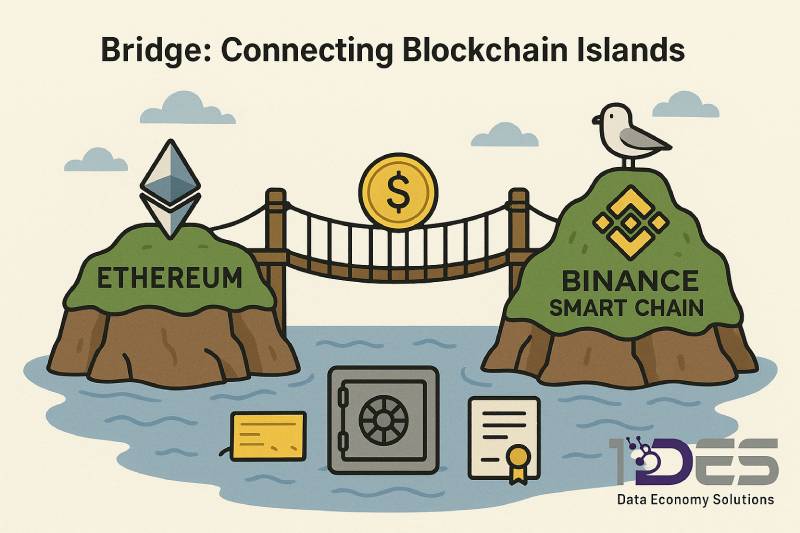
Each blockchain is its own island. Want to move tokens between Ethereum and Binance Smart Chain? You need a bridge.
Bridges lock your asset on one chain and create a copy on another. But beware: bridges are common targets for hacks. Security is critical.
Analogy: Like sending gold from one country to another and getting a certificate in return. If the vault is hacked, your gold might be gone.
On-Chain Data: The Footprints on the Trail
Every action on a blockchain is public. This data—wallet balances, trades, and staking—is called on-chain data. It's a treasure trove for analysis. You can spot trends, follow whales (big investors), and find promising tokens before they explode.
It's like being able to see who's buying land before a mall is built.
Oracles: Bringing Reality into the Blockchain
Blockchains are sealed environments. They don't know real-world data. Oracles solve this by feeding in external info: prices, weather, sports scores, etc.
Example: A DeFi protocol needs the ETH/USD price to process a loan. It uses Chainlink (a popular oracle) to get this data from exchanges.
Analogy: Like hiring a messenger who reports what's happening outside the castle.
Wallets: Your Digital Keys to the Kingdom
You can't do anything without a wallet. A crypto wallet holds your private keys, the password to your funds. Types:
- Hot wallets (connected to the internet, like MetaMask)
- Cold wallets (offline, like Ledger)
Real-world analogy: Like carrying cash (hot wallet) vs. storing it in a safe (cold wallet).
Governance Tokens: Voting Rights in a Protocol
Some DeFi platforms give you tokens that act like votes. Holders decide on upgrades, fee structures, or partnerships.
Example: UNI holders vote on Uniswap's future decisions.
DAOs: Online Organizations That Run Themselves
DAOs (Decentralized Autonomous Organizations) are communities governed by code. They make decisions based on proposals and votes.
Think of them like a cooperative company: no CEO, no HR, just rules and votes.
DexTools & Analytics: Your Data Dashboard
Navigating DEXs without tools is like driving without GPS. Platforms like DEXTools, GeckoTerminal, and DefiLlama give you charts, trading volumes, whale movements, and token health metrics. They help traders find early gems or avoid scams.
AI Tools in DeFi: Smarter Decisions, Faster
AI is being used to:
- Detect rug pulls (exit scams)
- Monitor unusual wallet activity
- Predict token price movements
- Summarize on-chain data
It's like having a research assistant who never sleeps and reads every new contract for you.
Automated Trading: Bots That Hunt for Opportunities
Trading bots can be simple (buy/sell when a price hits) or complex (using machine learning to predict moves).
In DeFi, bots:
- Monitor liquidity pools for arbitrage
- React instantly to price changes
- Front-run based on public transaction queues (MEV)
These bots are fast, efficient, and emotionless.
Wrapping it all together, let's say you:
- Use your wallet to swap USDC for ETH on a DEX
- Stake your ETH on a DeFi protocol for interest
- Track your earnings with DEXTools
- Use an AI bot to monitor the market
- Vote on protocol changes with your governance tokens
You've just navigated blockchain, DeFi, staking, DEXs, tools, and automation all without leaving your chair. That's the beauty of this world: it's open, programmable, and constantly evolving. And now, it's a little more understandable, too.
BLOCKCHAIN DEFI TRADING AI