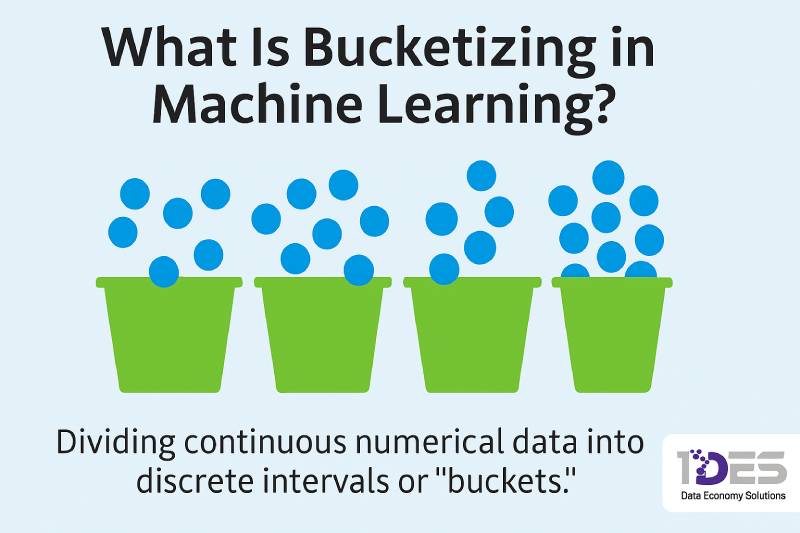
What Is Bucketizing in Machine Learning
Maryam
Published on Dec 15, 2024
Making Data Easier to Understand and Work With
Bucketizing, also known as binning, is a technique in data analysis and machine learning where continuous numerical values are grouped into discrete intervals or "buckets." This transformation helps convert complex, continuous data into simpler, categorical or ordinal data, making it easier to interpret and analyze.
How Does Bucketizing Work?
The process involves defining the width or range of each bucket and assigning each data point to a bucket based on its value. For example, suppose you’re working with a dataset of ages ranging from 1 to 100. If you bucketize them into groups of 10, you’d get intervals like 0–9, 10–19, 20–29, and so on. Each age is then slotted into the appropriate range.
Why Use Bucketizing?
-
Simplifies Analysis
Breaking continuous data into categories helps reveal patterns, trends, and distributions that may be harder to spot otherwise. -
Handles Outliers More Gracefully
By grouping extreme values into boundary buckets, bucketizing can minimize the impact of outliers on your analysis. -
Reduces Noise
Aggregating similar values into a single category can smooth out fluctuations and provide a clearer picture of the data. -
Facilitates Comparisons
Categorical buckets make it easier to compare different segments of data, aiding both summarization and group-based analysis.
Where Is Bucketizing Used?
Bucketizing is widely applied in fields like finance, customer segmentation, marketing analytics, and survey analysis. In machine learning, it can serve as a preprocessing step for models that handle categorical data better than continuous inputs.
A Word of Caution
The way you define your buckets—size, number, and boundaries—can significantly affect your results. Arbitrary or poorly chosen buckets may mislead your interpretation. It’s crucial to apply domain knowledge and exploratory analysis when deciding how to bucketize data.